

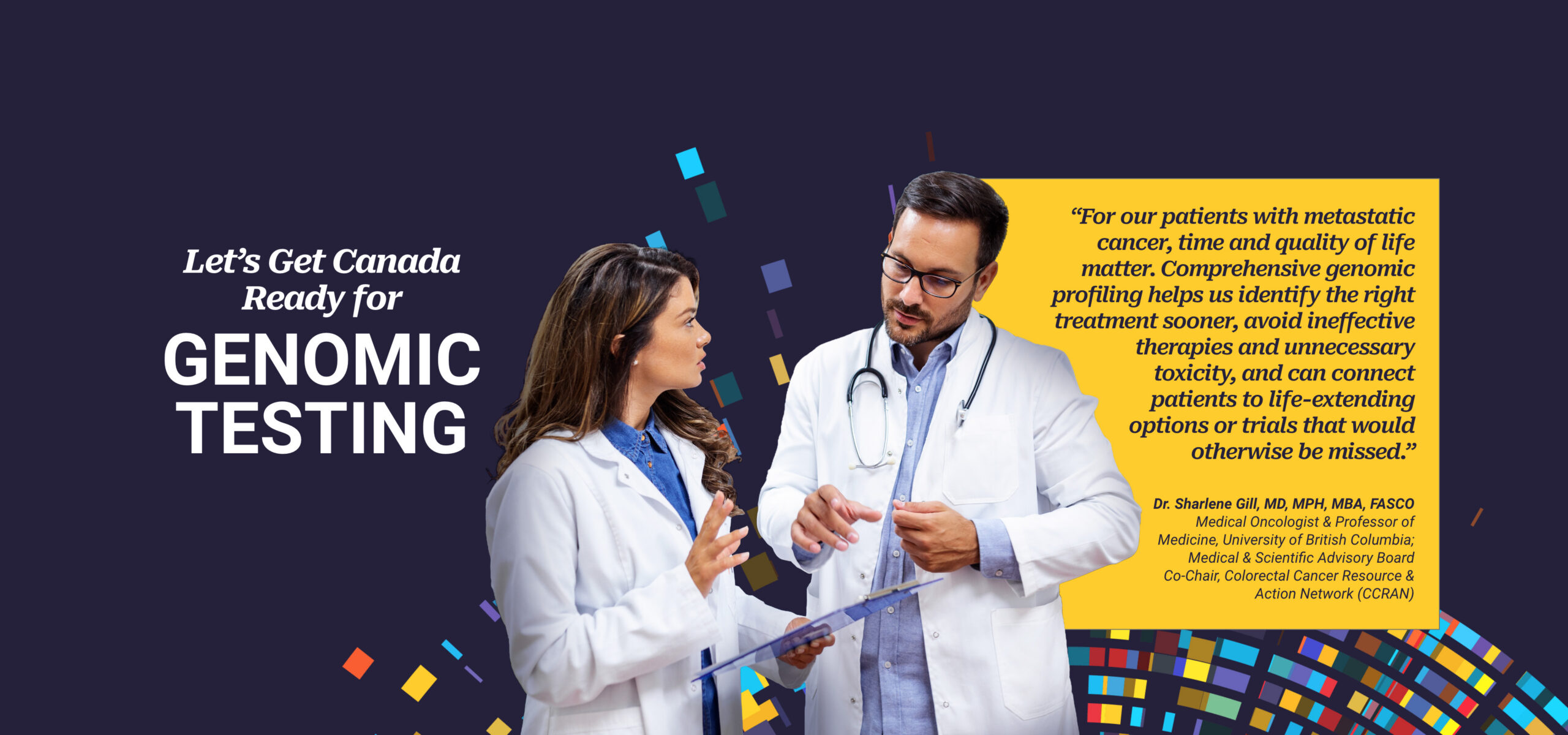










We need action from policymakers across Canada to ensure we are continuing to ready our healthcare system for genome-based testing, so patients can benefit from where science and innovation is today – and where it’s headed in the future.
Effective healthcare takes knowing about the nature of the underlying disease.
That’s where genomic testing comes in.
Genomic testing looks at the patient’s genes to know more about what condition they have, what outcomes can be expected and how likely they may respond to a given treatment or therapy. It empowers better clinical decisions and in turn, can lead to better patient outcomes and much-needed innovation.
Genome-based tests evaluated for use in Canada and abroad over the last several years have described the following benefits on patient health which have been accepted by health technology assessment bodies:

Reduces severe toxicities from drug therapy or the need for drug therapy.

Avoids invasive procedures and reducing unnecessary surgeries.

Improves response to medication.

Reduces the need for additional diagnostic tests (including invasive biopsy).

Improves time to diagnosis.

Reduces medication burden.

Reduces the number of specialist referrals and follow-up visits.
It’s a gamechanger – for Canadians living with cancer, rare diseases and for future-proofing Canada’s health systems.
Progress towards equitable access to genome-based testing will bring Canada’s health systems closer to realizing the “Quadruple Aim”.

Better Patient and Caregiver Experience
Faster and better access to innovative care

Greater Efficiency, Savings and Value
Reduced red tape and waste, while making provinces more attractive for research funding and clinical trials

Better Care Provider Experience
More coordination among providers of lifesaving care

Stronger Population Health Outcomes
Reduced system-wide inequity and meeting the current and future needs of Canadian patients

Is Your Province Ready?
Countries around the globe are accelerating their progress on genome-based testing. Canada has made some progress – but we’re far from ready. There are still significant gaps in data, education, financing and more.
Patients don’t have time to waste. Read more about the state of readiness for routine genome-based testing across Canada and see what actions your province can take.
Alberta Grade B+
Alberta, along with Newfoundland and Labrador, lead Canada in readiness for genomic medicine, maintaining its B+ grade.
Its strengths include a single service organization (Alberta Precision Laboratories, or APL) for oversight and resource planning, established integration of laboratory information across the province, and dedicated translational research programs that incorporate investigational testing. APL engages with all clinical stakeholders and patients, leading to a strong foundation.
Alberta’s transparency in its evaluation framework, including timelines and criteria, is also a key strength. To further enhance its leading position, Alberta needs to address:
- The limited structured opportunities for exchange with innovators outside the health system.
- While APL has flexibility in releasing funds, its reliance on research funding for test development means that priorities can be influenced by funders rather than societal need or equity. A clear, value-based funding formula is still needed.
- While education and training occur, province-wide standards to ensure consistency in the quality of testing service must be established.
Alberta should expand formal opportunities for engagement with external innovators, implement a more transparent and needs-driven funding formula for test development, and establish province-wide educational and training standards.
Read the 2024 report here.
British Columbia Grade C
British Columbia (B.C.) has maintained its C grade, indicating that while some efforts are underway, system readiness for genomic medicine has stalled.
Strengths include a single service organization (B.C. Provincial Laboratory Medicine Services, or PLMS) for resource planning and facilitating service coordination. PLMS also serves as a single point of entry for new innovation proposals.
B.C. has embraced investigational testing and translational research through its Genome Science Centre, showing forward-thinking in its approach. B.C.’s regionalized health system structure presents challenges, particularly in:
- A lack of integrated laboratory information systems hinders seamless data exchange, despite ongoing projects to create federated data commons.
- While PLMS provides an entry point, broader stakeholder engagement and opportunities for innovators outside the health system are limited, making it challenging for them to understand system priorities or contribute effectively.
- The province lacks comprehensive test directories or protocols, and province-wide educational standards for care providers are still under development, impacting timely and effective care.
- The reliance on a volume-based funding formula, historically designed for community-based testing, does not adequately account for the additional human resources and development costs associated with genomic testing.
B.C. should accelerate the integration of laboratory information systems, broaden engagement with external innovators, publish comprehensive test lists and protocols, and establish clear province-wide educational standards for care providers.
Read the 2024 report here.
Manitoba Grade B-
With a grade of B-, Manitoba is somewhat ready to adopt new tests, using its centralized single service organization to remain nimble and responsive to clinical needs.
Manitoba excels at integrating innovative testing by anticipating future testing needs and planning for their adoption.
Gaps faced by the province include lack of broader health system engagement and transparency and an inflexible funding model.
Recommendations for Manitoba include improving their testing financing approach, creating systemic resource planning, and establishing a more transparent, standardized evaluation process.
New Brunswick Grade B-
New Brunswick is well-positioned to consider and adopt new genetic and genomic tests, with a B- grade. It benefits from regional collaboration and innovative testing anticipation.
Outside of cancer, the province leverages its participation in the Maritime Medical Genetics Service (MMGS) to create efficiencies of scale and provide equitable access to care.
The area in which the province could improve is through its financial approach, by implementing discretionary spending and resource planning, as well as increased decision transparency.
Priority actions should include the establishment of anticipatory planning, dedicated funding for the development and delivery of new tests and work toward standardizing evaluation frameworks.
Nova Scotia Grade B
Nova Scotia has achieved significant progress, moving its readiness grade from C- to B. This improvement is attributed to better information linkage, an enhanced evaluative process for new proposals, and advancements in education and regulation (quality) of service delivery. Its smaller size and centralized health authority (NSHA) facilitate nimble adoption and coordination of new testing, including the early integration of investigational testing into mainstream care.
Despite these strides, Nova Scotia still has areas requiring improvement to optimize genomic medicine:
- The pathway for considering and adopting new tests is not fully transparent, with multiple routes of entry and limited stakeholder engagement. There is no single point of entry for onboarding new tests, restricting proposals to NSHA personnel.
- A lack of geographically integrated laboratory information systems across key service delivery centers remains a challenge.
- While a test directory exists, it is not comprehensive, and province-wide standards for education and training for care providers are still under development.
Nova Scotia should establish a transparent, single-entry point for onboarding new tests, clearly defined funding formulas for test development, and comprehensive province-wide standards for education and training to further integrate genomic medicine effectively.
Read the 2024 report here.
Ontario Grade B
Ontario has achieved significant progress since 2023, moving its readiness grade from D to B, particularly with the establishment of the Provincial Genetics Program (PGP). The PGP is designed to coordinate service delivery, support resource planning, and develop province-wide standards for education and care navigation.
They have also embraced investigational testing which uses clinical trials and research-based testing to evaluate new genetic and genomic technologies, and are working towards integrating translational research into mainstream care.
Despite this progress, Ontario faces significant challenges due to its highly decentralized healthcare environment:
- The current process for considering and adopting new tests is fragmented, with multiple routes of entry and limited stakeholder engagement, making it difficult for innovators to navigate and for the system to identify priorities.
- A lack of linked information systems hinders seamless integration of laboratory and health information, which is critical for supporting genomic medicine.
- The current finance approach is reactive, lacks dedicated funding for test development, and is often influenced by who is paying rather than systemic need, leading to delays.
- While the PGP is developing standards, a comprehensive, province-wide educational strategy for care providers and patients is still needed.
Ontario needs to create a transparent, single-entry point for new test proposals, standardize evaluation processes, and improve stakeholder engagement to ensure timely and equitable access to innovative genetic and genomic testing.
Read the 2024 report here.
Newfoundland and Labrador Grade B+
Newfoundland and Labrador is tied for the highest grade, alongside Alberta, receiving a B+ grade, showing a strong system readiness to consider and adopt new tests.
The province has one of the most transparent processes in Canada, providing clear guidance to patients, providers, and innovators on what is valued and funded.
Gaps include heavy reliance on out-of-country providers for genomic testing and reactive financing as opposed to a dedicated, proactive budget for discretionary spending and test development.
The province should prioritize repatriation of CGP back to the province, implement anticipatory resource planning, dedicated discretionary funding, as well as education and training.
PEI
As the country’s smallest province, Prince Edward Island (PEI) does not have the in-house capacity to conduct specialized genetic and genomic testing.
The province relies on a cross-billing referral basis to established centres in Nova Scotia to deliver genetic testing services to its residents.
As PEI’s system readiness is a shared responsibility with external partners, its success is partially tied to the continued funding, modernization and readiness of health systems in Nova Scotia.
Quebec Grade B-
Quebec has made significant reforms to its laboratory governance since 2011, and has maintained its B- grade.
Key strengths include systematic oversight and resource planning through the Direction de Laboratoires et Imagerie Médicale (DLIM) and a single supra-regional network (Réseau Québécois de Diagnostic Moléculaire – RQDM), which also acts as a single point of entry for new innovation proposals.
As of spring 2026, CGP in cancer is reimbursed in Quebec for certain indications. Notably, this announcement came after the release of the State of Readiness 2.0 report, marking a significant achievement and one of the first developments of its kind across the country.
Quebec has a well-defined and consistent evaluation process through INESSS, and a nimble financing approach that considers test development and additional resource costs.
Despite its progress and early reforms, Quebec still has areas for improvement:
- The reliance on single centers for operations can lead to documented service delays and hinder equitable access. Further coordination, particularly in oncology, is needed.
- Although a test directory is published, it lacks information regarding available tests and access, leading to navigation challenges for care providers and patients.
- Investigational testing is not funded, and the opportunities for broader clinical research and attracting innovation are limited to translational research programs.
- Province-wide standards for education and training in development are still needed.
Quebec should improve navigation tools for care providers and patients, expand funding for investigational testing to foster innovation, and finalize province-wide educational standards to ensure consistent and equitable service delivery.
Read the 2024 report here.
Saskatchewan Grade C
Earning a C grade, Saskatchewan has established some necessary conditions for testing—particularly within cancer care—but lags behind in other critical areas of readiness.
Systematic oversight and resource planning are well-established for hereditary testing and molecular cancer testing.
Primary gaps include poor information management and decreased transparency of, and support for, genetic and genomic testing.
The priority for Saskatchewan should be to improve the linkage of laboratory information systems, restore and publish a comprehensive test directory, and develop formal, standardized processes for testing outside of cancer.
Territories
To optimize specialized public resources, the Territories leverage interprovincial partnerships for genetic and genomic testing rather than duplicating high-cost laboratory infrastructure due to population size and geographic distribution.
The Territories operate on a cross-provincial billing referral basis:
- Yukon refers patients to established centres in British Columbia and Alberta.
- Northwest Territories refers patients to established centres in Alberta.
- Nunavut refers patients to a network of established centres across Ontario, Manitoba, and Alberta.
As the Territories’ system readiness is a shared responsibility with external partners, its success is partially tied to the continued funding, modernization and readiness of health systems in their partner provinces.
Access to Genomic Testing is a coalition of patient advocacy organizations, care providers and innovative pharmaceutical and diagnostic companies that have come together to raise awareness around unlocking the potential of genome-based testing in Canada.
Support for The Update to the State of Readiness Progress Report was provided to the lead researchers, Don Husereau and other experts, including Filomena Servidio-Italiano, from innovative pharmaceutical and diagnostic companies.
Join us in advocacy and share your story
Access to Genomic Testing is a coalition of patient advocacy organizations, care providers and innovative pharmaceutical and diagnostic companies that have come together to raise awareness around unlocking the potential of genome-based testing in Canada.
Support for The Update to the State of Readiness Progress Report was provided to the lead researcher, Don Husereau, from innovative pharmaceutical and diagnostic companies.